What Kind of Personality That Is Well Suitied for Fashion Desingers
To be a skilful designer, you need more than just mastery of design skills and a good heart. With more and more companies hiring waves of designers, yous must have all the skills needed to thrive within a larger product team.
Photo credits: Lovelorn Poets
In this piece, we'll describe some of the personality traits that help the designers in all aspects of their work, from satisfying users to working with stakeholders. Remember that one simply isn't "born with" these traits (although a few may come up naturally to some designers). These traits tin can be learned, developed, encouraged, and nurtured, transforming you into a better product squad – and a better designer.
If you'd like more tips and case studies on better UX & UI design, check out the free eastward-books Web UI Best Practices and Interaction Design Best Practices.
1. Compassionate
Empathy is arguably the most of import trait of a designer. You won't get very far in pattern if you lot don't empathise your users, and you won't become very far in business organisation if yous don't empathise your teammates.
Empathy serves a dual purpose.
The first function is emphasizing your users, which is pretty self-explanatory. If you understand what your user wants versus needs (and how they think), you're in a much better position to design intuitive and desirable interfaces – which is especially important since people make decisions emotionally rather than rationally.

Source: " Empathy ." Sean MacEntee. Creative Eatables .
For empathizing with users, usability testing can open the near doors into their mindsets. Reliable data takes a lot of the risky guesswork out of pattern, especially considering that the designer is rarely the target audience, so there's always an element of uncertainty. Effort to understand your users equally much as possible, and fill in the remaining blanks with user research.
As described in Pattern Collaboration for the Enterprise, empathy also improves collaboration. Designers are trained very well in empathizing with users, but don't forget to sympathize within your squad.
Study the culture and processes of your own company equally though you were an outsider. Why are things washed the style they are, and what are the processes that accept created the existing blueprint artifacts? If the visitor struggles with being design-focused, some internal ethnography helps give you a better understanding of cultural issues and realistic workarounds.
Empathy is specially helpful during critiquing sessions: phrasing a criticism in the proper manner volition spare feelings, and likewise increases the likelihood of you winning over advocates in the company.
For 8 tips on how to go more empathetic, read this fantastic commodity from UX Mastery.
two. Business-Savvy
With all the visual details involved, it tin can be easy to forget that design is a business organization.
Equally a designer, your own personal preferences and opinions come 2d to the business goals (and user goals) of a project. If a carousel performs well in usability tests, you lot might desire to include it in your UI even if you personally detest it. Existence business-savvy means making simply the decisions that are skilful for users (and therefore business) – and that starts with knowing how.

Photograph credit: Canned Muffins. Creative Commons .
Like we mentioned in a higher place, usability testing reveals smarter paths to satisfying user and concern goals. The more y'all understand your users and their behavior (Empathy), the more-informed your business decisions.
Beyond studying users, designers need to also grasp why projects were initiated in the showtime place and how the company measures product success.
How does the business organisation model work? Where does the current product you're designing fit into long-term goals? Who are the tiptop competitors, and what are their strengths and weaknesses? You probably won't know the answers right abroad (and sometimes stakeholders might not fifty-fifty tell you lot upfront), so it's your responsibleness to tease out the data from the correct people.
Sit in on sales demos, interview stakeholders, exercise whatever you tin can to understand why and how the visitor turns a profit. "Designers that tin can't talk to value in the business model also can't explain why they themselves should be on the payroll," says usability expert Jared Spool in an fantabulous article from his site User Interface Engineering.
To ensure you're always a business asset, you lot need to have the initiative and learn beyond the daily grind. Personally, nosotros're big fans of staying updated with Corking Magazine's Business organization section and Google Venture's Library. They both provide practical pattern perspectives on very real and pressing business issues.
three. Empirical
The best designers can think like scientists.
As nosotros just said, design is a concern, and so products cannot exist built on the whimsy of the designer'due south creative spirit. Yous demand concrete inquiry backed by quantitative and qualitative user data.

Source: " The Poetry of Logic ." Quinn Dombrowski. Creative Commons .
Web analytics, usability tests, and contextual interviews lend credibility to your intuition (or preclude you from making irreversible mistakes). Non merely will these brand your designs better, it will besides be a great help when defending your design choices in a review. If someone challenges your decisions, let the user data speak for itself.
Alissa Briggs, Brigade'south Director of UX, presents a great empirical approach to design bug. We start learned of her approach at Rosenfeld Media's Enterprise UX 2015 conference.
When Briggs worked at Intuit, client feedback showed that their users would prefer a simplified product with multiple tiers under i license. Feedback alone wasn't plenty, notwithstanding, since executives chop-chop shot down the idea.
That'southward when Briggs broke out her experiment grid. This is a quick and effective spreadsheet for conducting pocket-sized experiments to validate or invalidate otherwise abstract theories. By using this document for testing a simplified product on a pocket-size ready of users, Briggs had the difficult data to back up the customer feedback.
One time the executives saw the hard data, they were immediately on board. Other departments even took notice and wanted to endeavour out the experiment grid. Now, the single-license product outsells all others.
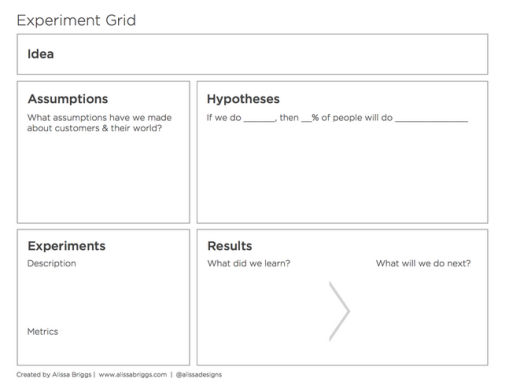
Photo credit: Alissa Briggs
Only don't become overboard. You lot have to know when enough is enough in terms of testing to avoid data fetishization – don't make the mistake Google did with their infamous 41 shades of blue exam.
For more communication on how to apply scientific testing into design, check out this slideshow on experimenting in Lean UX.
4. Meticulous
In a medium based in visual minutiae and the intangibles of psychology, an eye for detail is crucial for consistent UI and UX design.

Source: " Spiders web, How Loma, Norfolk ." Willzay. Creative Commons .
Cracking designers pay attending to the details. No aspect of the site'south interface is too small-scale, too insignificant. For case, the fine art of interaction design requires that you pay attention to how each microinteraction (which lasts milliseconds) affects an overall experience (which can span minutes or hours). Information technology might seem nitpicky to deliberate over a hover-to-reveal versus click-to-reveal, merely usability testing usually reveals otherwise.
Part of being meticulous means maintaining consistency, as explained in Consistency in UI Blueprint. Grids, layout patterns, colour palettes, editorial styles – these must all remain consistent across all the pages of a website, or else y'all take a chance users relearning functionalities (which increases friction).
One time y'all finalize these decisions – color codes, and typography specifics, etc. – try organizing them with a manner guide. A quick reference guide (best created in HTML with reusable code) helps salvage a lot of the strain of ensuring site-broad consistencies.
five. Patient
When you're at the nth iteration, it'south piece of cake to but cave in and say "good enough". Deadlines loom and sometimes compromise is the path of least resistance.
But like we described in Consistency in UI Blueprint, always take the time to verify that your designs are commencement externally consistent (match what users expect) and internally consequent (consistent with itself).
Some clients might not observe, but others may require stringent reviews where they will ask uncomfortable questions about why certain fonts in a wireframe aren't consistent, or the spacing looks off from page to folio. You tin try pre-empting those comments by explaining that it's just a wireframe, but you're better off just putting in some extra attempt to avoid the conversation completely.

We're large believers in spending more time upfront on the blueprint foundation, so we propose y'all first refine the data architecture and test it with users via card sorting. Y'all tin so motility into a rapid image – even an interactive wireframe – to explore how your design really works before diving into visual details.
If possible, create some crude copy (or use competitor's copy) instead of taking the Lorem Ipsum shortcut. At this rough phase, the image is likely to require rebuilds, so don't commit to higher allegiance than needed for usability testing.
Patience is equally important when testing and interviewing users. Don't but write up a list of questions, run through them with users like a script, and call it a day. Many times, you'll notice the best user insights are hidden in the pauses between questions. Utilize your list of questions equally a crude prompt, and so dive deeper with follow-up questions (Liz Danzico provides some great guidance in her presentation)
6. Perceptive
Solving problems is an everyday responsibility for the designer. Finding the right problems to solve, afterward all, is at least one-half the task.
You need to be able to run across outside the design. It'south easy to just get on the grind when you've been working on the aforementioned project for months, so you start treating the end-date as a light at the end of the tunnel. Simply dandy designers have the uncanny power to nevertheless run into their design as if information technology were the first fourth dimension, even if they've worked on it for what seems like forever.

Source: " Innovación ." Ruta Due north Medellín. Creative Commons .
While some designers are born with that skill, others can build up that strong perspective through user-focused exercises like empathy mapping and usability testing. In fact, endeavour moderating a few usability testing sessions for rare glimpses into aboveboard user behavior. You'll naturally internalize their reactions for fresh perspectives on future iterations.
When speaking at Rosenfeld Media'due south Enterprise UX 2015 conference, Catherine Courage, SVP of Customer Experience at Citrix, also suggested finding inspiration exterior your manufacture. It tin can exist as simple as looking at the brands yous yourself love, and trying to incorporate those characteristics into another industry where they're non mutual.
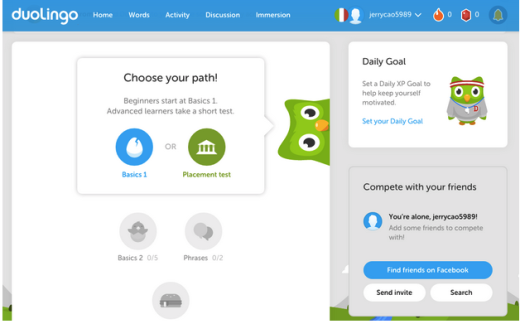
Photo credit: Duolingo
For example, Duolingo incorporates the delightful design elements from mobile gaming apps into language learning. As a issue, the learning experience feels more enjoyable past shedding the academic experience. Patterns like unlocking achievements, gratifying incentives, fun colors, and cartoony graphics all counteract the traditional classroom feeling.
To develop these unprecedented design solutions, you must exist willing to question the constraints. Pay attending to assumptions, seek inspiration outside your industry, and start making those unseen connections.
7. Grounded
The concluding trait that ties everything together is being grounded.
A firm sense of reality is the central to effectively applying all of the higher up traits. By seeing the problems at hand and resisting the temptation to sugar-coat them, you lot'll develop a improve understanding of how to legitimately solve them.

Source: " Anxiety on the footing ." Felipe Gabaldón. Creative Eatables .
Existence downwardly-to-world gives you the openness to sympathize others (empathy). It allows you lot to meet how things really are (empirical) so you can accept how they relate to the project'south specific goals (business-savvy). Keeping your anxiety on the ground reminds you to accept your fourth dimension (patience) on filing in the details (meticulous), and provides a reliable anchor and so you can safely explore new ideas (perceptive).
Conclusion
We can't possibly list all the groovy traits that help designers – humility and ambition are ii traits that are often cited, and for skilful reason.
These are merely the ones that that stand out in our minds, and the qualities nosotros've observed in the best designers we know. While these seven lone may or may not be the secret to becoming a not bad designer, nosotros can say 1 thing with confidence: they certainly never injure whatever designers.
If you'd like to acquire more techniques of great web designers, check out the complimentary 109-page e-book Web UI Pattern Best Practices. The book explores techniques spanning UX blueprint, visual design, and interaction pattern. Examples are analyzed from 33 companies including Apple, Spotify, Skullcandy, and others.
Read Adjacent:The ultimate guide to launching your UX career
Image credit: Shutterstock
0 Response to "What Kind of Personality That Is Well Suitied for Fashion Desingers"
Post a Comment